
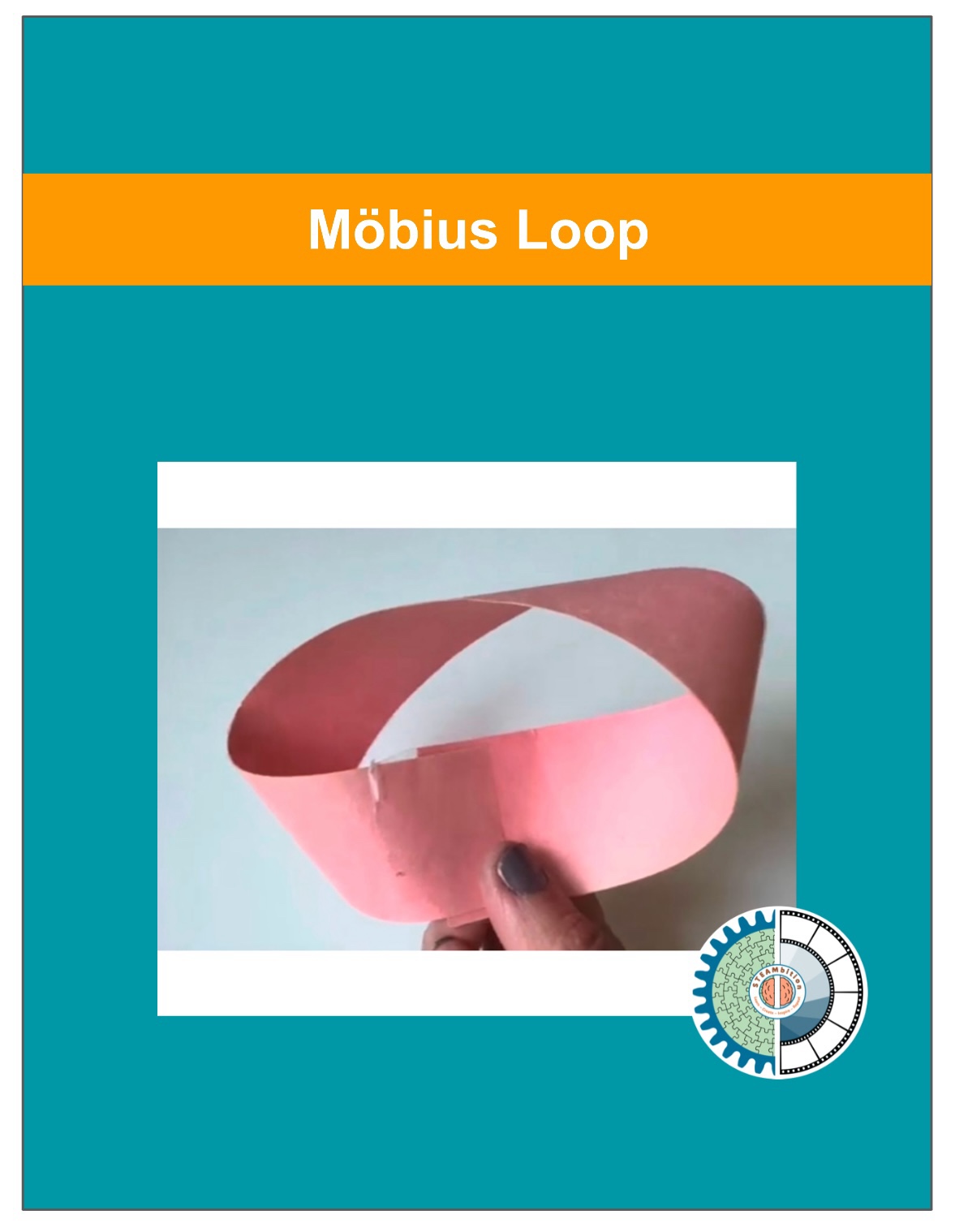
The Möbius strip was discovered by German mathematicians August Ferdinand Möbius and Johann Listing in 1858. The Möbius strip is a non-orientable surface, meaning that it has only one side. If you start drawing a line along the center of the strip, you’ll eventually return to the starting point, but on the “other side” of the line.
Materials Required
- A piece of paper
- A pair of scissors
- Glue or tape
Method
- Cut a long strip of paper that is about 10 inches long and 2 inches wide.
- Twist the strip once and tape the two ends together to make a ring.
- Ask your kid what would happen if we cut down the ring in the middle?
- Cut it down in the middle. Did it make two rings or one ring?
- When you slice the Möbius strip down its center, you are actually forming a new loop. Due to the inherent twist in the original strip, this action does not yield two distinct Möbius strips. Instead, you are left with a single elongated loop. It’s amazing to see how it turns into just one big ring and not two rings like what most people would think.
Can you think of some applications of möbius strips? Remember, since the strip can run in an infinite loop and in a twisted pattern, you can utilize both sides of the strip. For example, the printer cartridge ribbons are designed like möbius strip to better utilize both sides of the ribbon. The Möbius strip has inspired numerous artistic and design creations, from sculptures to furniture.
There is another familiar symbol where you must have seen a Möbius loop. Can you think where?
.
.
.
Think…
.
.
.
Think…
.
.
.
It is a triangle composed of three arrows looping back on themselves in clockwise direction. Yup, it is the recyclable waste symbol!

Any product that contains this symbol indicates that the product can be recycled (but not necessarily made from recycled materials). Check some of the other fascinating Möbius modification activities below.
Paper Loop Modifications
- What happens if you combine two Möbius strips and cut those from centers?
- What if you add more Möbius strips in the chain?
- How many combinations can you create, and do any produce identical shapes?
Check these projects to get some answers-
Leave a Reply