
The Fibonacci sequence is a super cool math concept with a rich history and some pretty surprising uses.
Where did it come from?
The sequence is named after Leonardo of Pisa, aka Fibonacci, who wrote about it in his book Liber Abaci back in the 12th century. He used it to explain how fast rabbits could breed in theory.
What is it?
The Fibonacci sequence is a series of numbers where each one is the sum of the two before it. It usually starts with 0 and 1, and then goes like this: 0, 1, 1, 2, 3, 5, 8, 13, 21, 34, and so on. The math behind it is pretty simple: each number is the sum of the two before it. Mathematically it can be defined as: n = n-1 + n-2, where n represents the nth term in the sequence.
Cool properties
One of the most famous things about the Fibonacci sequence is its connection to the Golden Ratio (phi). As the sequence goes on, the ratio of each number to the one before it gets closer and closer to 1.618. This ratio shows up all over the place in nature, art, and design.
Where does it show up?
You’ll find the Fibonacci sequence in all sorts of natural patterns, like the way leaves are arranged on stems, the spirals on pinecones, and the branching of trees. Artists and architects have used the Golden Ratio to create balanced and harmonious designs. Even traders use Fibonacci numbers to predict market trends! And in computer science, the sequence is used in algorithms for searching and sorting.
Activity- Make a Fibonacci art piece
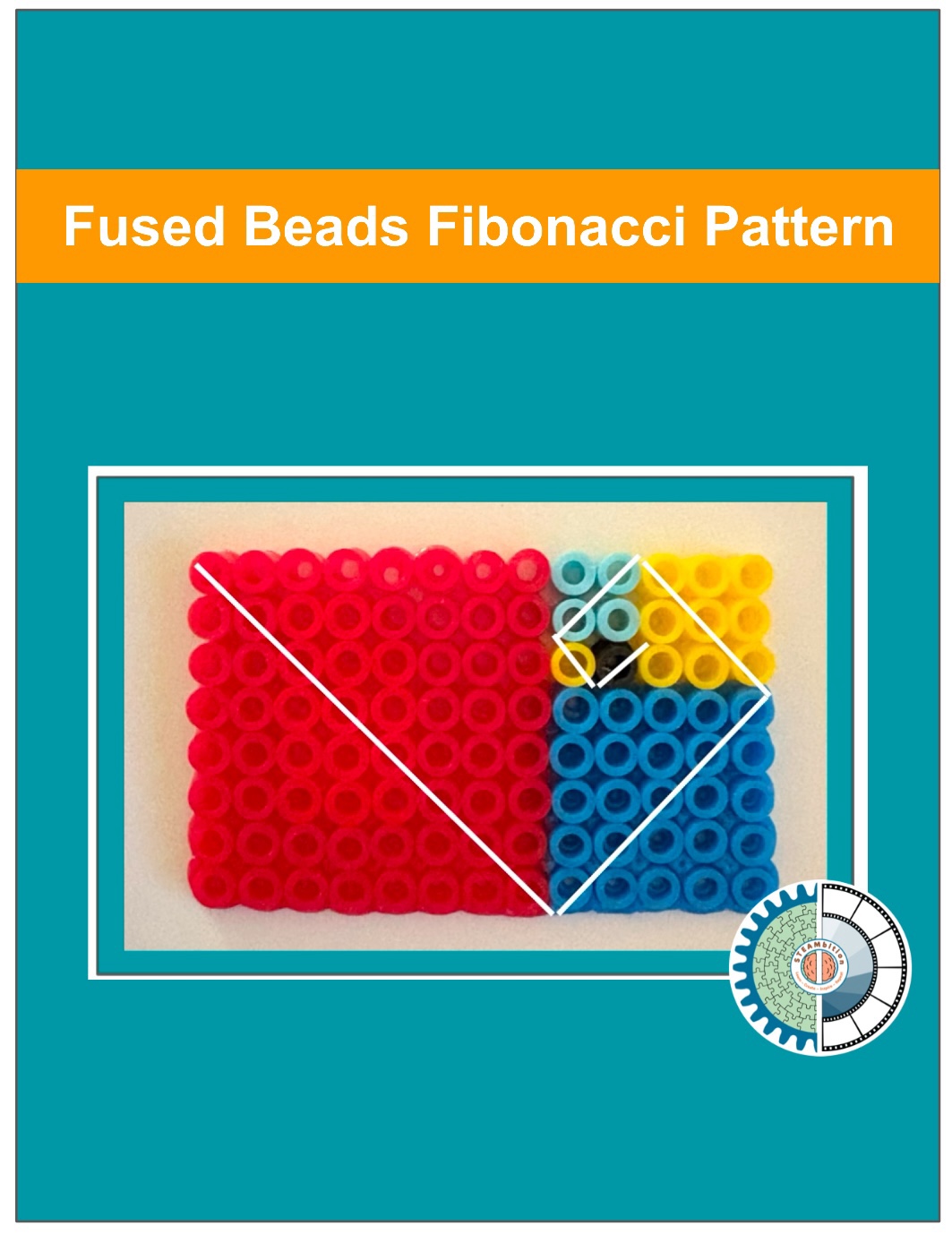
Use Fibonacci numbers to create a geometric art piece, such as a mosaic or a collage. We used fused beads artwork to create a Fibonacci tea coaster, check below for instructions.

- Collect a bunch of melty beads and a plastic support for the fused beads artwork. If you have any leftover from an existing kit, you can totally use it for this project.

- Begin by arranging beads in a Fibonacci sequence pattern. Start with placing one bead on the board.
- Next, add a different color bead next to it to represent 0+1=1 in Fibonacci sequence.
- Continue adding adjacent beads in a square pattern with side lengths in the Fibonacci sequence (1, 1, 2, 3, 5, 8, …).
- As shown in the image below, use different colors to enhance the visual effect.

- Once you are happy with your pattern, place a wax paper on top of the beads.
- Finally, fuse the beads using iron. Make sure to keep kids away from the iron to prevent any injuries.
- Your Fibonacci tea coaster is ready!

This art has become our family favorite this summer. Hope you enjoy making it too.

Leave a Reply